
Content Writing
Content is a production problem, not an inspiration problem
Most content plans fail on the calendar, not the concept. We write the words and keep producing them — to a brief you approve, on a schedule you can plan around — for businesses across the Detroit and Miami metros.
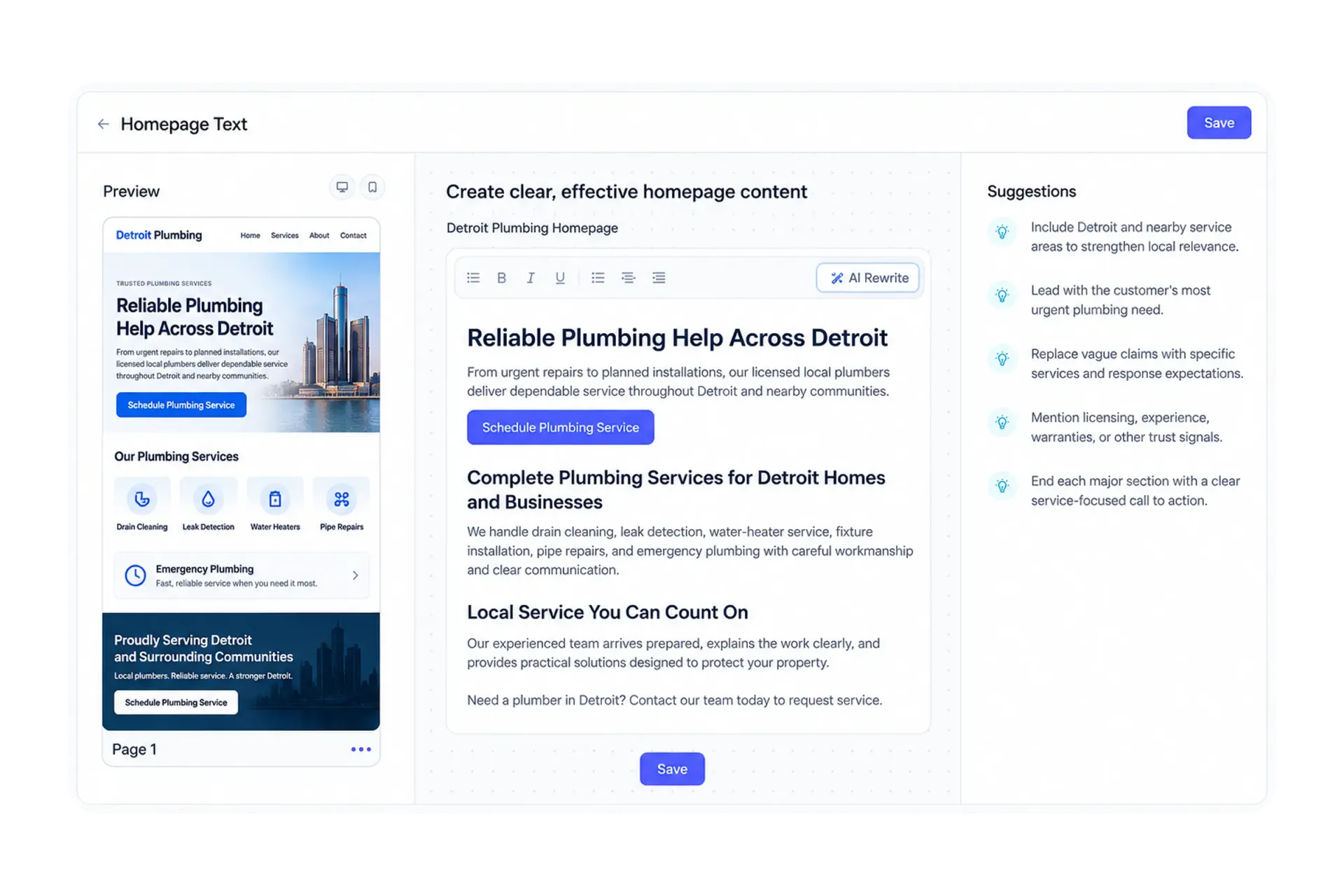
Why content stalls
The strategy was never the problem. The schedule was.
A content plan rarely fails because nobody had good ideas. It fails because the first genuinely busy week wins, the next piece gets pushed a day, and a day becomes indefinite.
The result is the same on most sites that sell something: the newest thing on the blog is the one written before the schedule collapsed, and the site quietly stops looking like an active business.
What this looks like
- Your most recently published piece is measured in months, not weeks
- Whoever has ten free minutes that week ends up writing it
- Nobody can say who is supposed to approve the next piece
- Pages exist, but nothing on them changes what a reader does next
- The list of things you meant to write only gets longer
The work
Three kinds of writing, each with a different job
These are not interchangeable — an article, a page and a guide earn attention in different ways and at different speeds.
-
Articles and blog content
Search-led pieces written to a real query and a real reader, not just a topic. This is the slow, compounding work.
-
Web copywriting
Homepage, service and landing pages. Fewer words, more argument per word, and one clear action at the end of each.
-
Long-form and downloadable assets
Guides, ebooks and resource pages you exchange for a contact detail, or hand a prospect mid-conversation.
Why it sits next to SEO
Written for a person, structured for a search engine
Content written only for a keyword reads like it was assembled, and readers leave — which search systems notice. Content written with no regard for what people actually search for gets read by almost nobody, however well made. We start from the query and the reader at the same time, then build the structural pieces search systems use to understand the page.
- Keyword and intent research before the brief, not after the draft
- Internal links planned across the piece set, not added afterward
- Titles, meta descriptions and headings written with the piece
- Existing pages refreshed where updating beats writing something new
What to ask for
The specifics that turn "content services" into a plan
"Content services" can mean four posts a month or one piece a quarter — the difference is in a handful of variables that belong in your written plan, not in a phone call you have to remember. We agree these upfront: what gets written, how often, how long, how many revision rounds, and what you're holding at the end.
- Volume and cadence — how many pieces, of what type, on what schedule
- Length — a target word count set per piece type, not a vague minimum
- Turnaround — brief-to-draft and revision turnaround, stated before work starts
- Revisions — a fixed number of rounds, set out in your plan
- Ownership — spelled out in your agreement, not left to assumption
- Bylines — under your name, a staff member's, or none, agreed per client
- Reporting — what was delivered against the plan, and when
Left undefined
- However many get done
- Whatever length works
- Ready whenever done
Set out in writing
- Cadence set in writing
- Target length per piece
- Turnaround set upfront
Process
Brief, research, draft, revise, publish
Every piece follows the same five stages, in the same order, so you always know what happens next and what you're waiting on.
-
Brief
The target query, the reader, the angle, the word count and the internal links, agreed in writing before anyone starts typing.
-
Research
Sources are gathered and dated as work progresses, so any figure that ends up in the draft can be checked now and rechecked later.
-
Draft
Written to the brief, in your voice, with headings, structure and metadata built in from the start rather than added afterward.
-
Revise
You mark up the draft and we revise it, for a fixed number of rounds set out in your plan before work starts.
-
Publish
Handed over ready to publish, or published directly to your site with the on-page setup handled — whichever you choose at the outset.

Common questions
Questions worth asking before you commission anything
If a question about scope, revisions or process isn't answered here, ask us directly — we would rather clarify it before you commit than after.
Do we need a content strategy before we start?
No — many clients arrive with a rough list of things they know they should have written and nothing more. We turn that into a plan: what to write, in what order, and what each piece is meant to do.
How many rounds of revisions are included?
The number of included rounds is fixed and stated in your plan before work starts, so revision is a defined step rather than an open-ended back-and-forth.
Can you write in our existing voice, or will it sound generic?
Every account starts with a short voice and style reference built from what you already have, and each brief is written against it — the aim is copy that sounds like your business, not like a template.
Do you only write for search, or do you write pages meant to convert?
Both, and they're treated as different jobs. Search-led articles are written to a query and a reader; web copy is written to move someone to a specific action on a single screen.
Do you publish the pieces, or just hand them over?
Either — you can take ready-to-publish files and post them yourself, or we can publish directly to your site and handle the on-page setup. That choice is agreed at the start, not assumed.
Next step
Send us the list you haven't written yet
Tell us what you know you should have published and haven't. We'll come back with a plan — what to write, in what order, and why.
No guaranteed results. New World Web Solutions does not guarantee search rankings, traffic levels, engagement or sales figures from any piece of content. What we commit to is the work described on this page and the deliverables set out in your written plan. Search performance depends on factors outside our control, including changes made by search engines themselves.